UTS Offers Intensive Courses toward Doctorate of Ministry

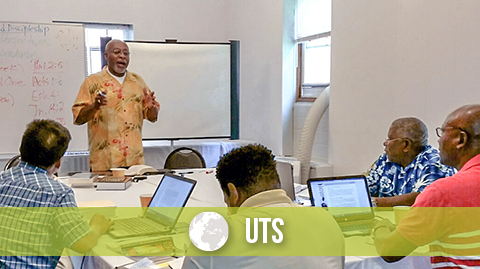
The dog days of summer are an intense “working vacation” for 12 members of the clergy in pursuit of the doctorate of ministry (DMin) degree from the Unification Theological Seminary (UTS). Annual intensive courses take place at the Barrytown, New York, campus of UTS during the first two weeks of August, as well as two weeks in February. The degree, which typically takes three to six years to complete, brings rewards which last a lifetime, according to Dr. Kathy Winings, UTS vice president for academic affairs. The DMin is a professional doctorate targeted at individuals involved in some form of ministry. Students concentrate on areas of study such as evangelism, pastoral counseling, spiritual formation, church growth, or church leadership.
“I had a wonderful time. I encourage people to come to UTS, where the professors are competent and very helpful,” said Dr. Brenda Frazer, who graduated from the DMin program in May 2015. “And people want to see degrees; they want to see some letters behind your name. I think that’s important.” Dr. Frazer leads the God’s Empowering Center in the New York City borough of Queens.

Dr. William Selig
“The DMin degree is very practical, because it is oriented to the work you are already doing,” said Dr. William Selig, a chaplain in Washington, D.C., hospitals since 2013. Dr. Selig, who also has been serving Unificationists with end-of-life issues since 2001, felt the need to develop and deepen his knowledge and skills. He began his DMin intensive courses in 2009 and received his doctorate in 2012. His dissertation project broadened his knowledge in every aspect of the Unificationist funeral rite known as the Seonghwa and led to the publishing of two seminal books.
Dr. Selig related that during his DMin coursework at Barrytown the student cohort was diverse and the dissertations varied and creative. One classmate, who had Native American ancestry, wrote her dissertation on the Native American storytelling tradition as a method for teaching the Divine Principle.
“The doctor of ministry degree is the right degree at the right time, because it is practical and effective for today’s diverse ministries,” Dr. Winings said. “Dissertation projects have focused on: increasing congregational participation in the church’s Bible studies and educational ministries; training directors of faith-based non-profits on how to utilize UN resources; improving the educational outcomes of the pastoral forums of the American Clergy Leadership Conference (ACLC); enhancing the effectiveness of prayer through understanding brain-based learning; assessing the impact of rites-of-passage programs for teenagers; and developing effective small-group ministries.
“The dissertation project allows students to address a specific issue or problem in ministry and to make recommendations from their study of that problem,” Dr. Winings told UTS News.
“The uniqueness of our program design is that, instead of taking one major research course that covers everything students need at the end of their coursework, I divided the traditional research course into four smaller modules that address the key elements of their dissertation project,” she said.
“The first module deals with: formulating the question that will guide their dissertation project; the second deals with creating the literature review; the third handles research design models and assessment of the data, and the fourth is writing the proposal,” Dr. Winings explained. “This makes the research content more manageable and allows a focused student to actually end up submitting their first draft of their dissertation project proposal and so graduate in a more timely manner,” she explained.
The coursework for the DMin program is completed through a total of four two-week intensive sessions held on the Barrytown campus. Students do most of their degree work at home, making it an economical degree – both time-wise and financially. After two years of intensives, which adds up to 28 credits, students can take the third year or more for conducting and writing their 6-credit doctoral dissertation project, for a total of 34 credits. “It is oriented for people who have a regular job and have a family, so they can fit it into their annual routines,” Dr. Selig said. Cost comparisons of other accredited theological schools granting doctoral degrees indicate that UTS is highly affordable, noted Joy Theriot, a UTS recruitment officer.
For the first time, Archbishop George Augustus Stallings, co-chairman of the ACLC and founder of the Imani Temple African-American Catholic Congregation, is teaching one of the intensive courses. The course is titled “Theological and Ethical Perspectives of Ministerial Leadership.” According to the UTS catalogue, “Students in this course will assess the theological and ethical issues of contemporary pastoral leadership with specific attention to their relevancy to the students’ own ministerial context. Utilizing case studies and ministry models, students will delve more deeply into the theory and practice of ministry to assist them in defining and shaping their continuing and future philosophy of ministry and their chosen model of ministerial leadership.”
Other courses being taught at UTS this summer include: “Spiritual Formation and Integration,” “The Changing Face of Society: Diversity and Its Impact on Ministry,” “Transformational Leadership for a Postmodern World,” “Dissertation Research Seminar I: Formulating the Question,” and “Research Design Strategies.”
The peer-learning model is key at UTS, according to Dr. Winings. “All DMin students are challenged to develop new insights into their ministerial effectiveness and leadership, to re-examine their own continuing theological and spiritual development in light of their present ministerial responsibilities, and to develop greater competency in their ministries,” she said.
“All students are expected to fulfill the requirements of the degree program while being engaged in their own practice of ministry – whether it is a congregational ministry, youth ministry, social service ministry or some other form of ministry,” Dr. Winings said. “The DMin is really one of the most exciting degree programs for those called to all forms of ministry.”
Contributed by Douglas Burton, MDiv (UTS ’82)


Nancy Nishi
| #
How can I learn more about the intensive course for the doctorate of ministry?
Reply
editorial
| #
Dear Nancy Nishi
Thank you for your comment. to learn more about the intensive, you can visit this link on the UTS site: http://uts.edu/course-listings/d-min-courses.html
Thank you
Reply
Adrienne Thornton
| #
Will we ever be able to obtain a degree in ministry online? My husband is handicapped and I am not able to leave him. I would like to work towards a degree at home, if possible. At the moment I bring him to work with me at the Kirov Academy of Ballet where I am the Artistic Director. When I retire from there I would like to have a degree and teach. Thank you.
Reply
editorial
| #
Dear Adrienne Thornton. Thank you for your comment. Please use this link to email the registrar at UTS with your question. Thank you
http://uts.edu/community/userprofile/registrar.html
Reply