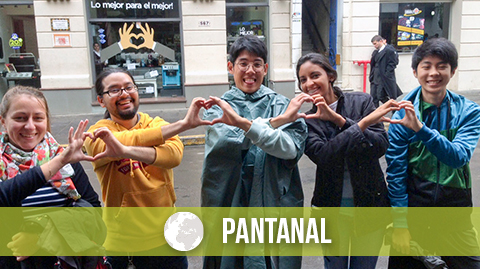
International Volunteers Have Eye-Opening Experiences in Leda
The Leda Project was established by True Father in 1999 in the wetlands of the Pantanal, a region shared by the nations of Paraguay and Brazil. True Father envisioned that it would become a place that would help solve the worldwide problem of hunger. This summer, teams of youth from many different nations are visiting for a few weeks at a time and helping in the many different activities at Leda, such as building schools in the local communities. Sunday, July 5, 2015 marked the beginning of the ‘Pathway to a Sustainable Future’ project in Leda, involving 30 youth volunteers from the USA, Japan, Norway, Germany, Canada, Venezuela, Uruguay, Honduras and Bolivia. The following is their blog of activities over the first two weeks of their volunteer activities.
Day 1: Arrival

Most of the 30 young volunteers arrived in Asuncion, the capital of Paraguay, the night of July 4 and in the early morning of July 5. Upon arrival, they met the seven staff members who will guide the project and attended Sunday service in the heart of Asuncion. The local Unificationist community welcomed them with open arms. After service, the volunteers and project staff members introduced themselves to members of the church and everyone shared lunch together. The remainder of the day was devoted to staff orientation. During this time, the participants spent time getting to know one another and getting ready to travel to Leda to start the project!
Day 2: Planning

On July 6, Rev. John Gehring began the project orientation by introducing the staff and outlining the project and schedule. Participants had the chance to go deeper with one another and discuss their hopes, concerns and expectations for the project. This activity proved beneficial for both staff and participants because their responses revealed something unique about each individual. Volunteers were assigned teams and tasked with creating team names. The project had only just begun and the participants were already very close with one another.
Day 3: Education

On Tuesday, July 7, the volunteers woke up bright and early to start the project. Following breakfast, the project staff organized an activity during which participants answered questions to discover where their personal attributes put them among the different leadership styles. They then toured the city, visiting the residence of the President of Paraguay, touring a historical museum, and checking out local shops.

In the latter half of the day, volunteers were asked to consider their mindsets when faced with challenges. As with previous activities, they used this opportunity to learn about themselves as they considered questions otherwise unexplored. Then, they met with the Universal Peace Federation (UPF) president of Paraguay, who shared a message with them about the work they would be doing.
What made this day particularly special was the inclusion of music before several of the activities. Both Spanish and English songs were sung to begin events, which set a uplifting and harmonious tone.

Day 4: Loma Plata
On Wednesday, July 8, the volunteers left for a Mennonite settlement in Loma Plata at 6:30 in the morning. The bus ride was long, but time flew by with upbeat conversation. When the group finally arrived, Mr. Sano, the director of the Leda project, joined the group for lunch at a nearby restaurant. Afterward, the group returned to their hotel and Mr. Sano spoke briefly about the history of the Mennonite settlement in Paraguay.

The staff arranged to have a member of the Mennonites give a presentation on the history of the Mennonites in the country and the efforts and progress they have made in the recent years. A tour of a Mennonite co-op dairy factory followed the presentation. Next door to the factory was a Mennonite museum that the participants briefly viewed. After, they made their way to a neighboring supermarket to sample the fresh dairy products.
When the group returned from their scheduled visits they found that the electricity in the hotel had gone out. They went to eat at a Chinese restaurant, and the restaurant was without electricity, too. This seeming problem became a blessing when the restaurant owner arranged to have dinner taken outside by candlelight and the glint of the moonlight.
Day 5: Arrival in Leda

Finally, on Thursday, July 9, the participants flew with their teams to Leda. Many of them commented on the natural beauty of the Leda settlement. In the evening, a brief meeting was held to discuss logistics for the coming days. Leda has proven as relaxing and picturesque as rumored. Turtles, snakes, parrots and a sunset were among several of the things noticed by those experiencing Leda for the first time.
Days 6-10: Esperanza Village
A four day excursion to Esperanza village and the village of “May 14th” left participants in bittersweet tears of sadness and joy upon leaving.
Four days without the modern conveniences of electricity and plumbing proved to be a challenge to some and an adventure to others. The experience was a profound one nonetheless. The excursion began with an hour and a half trip by boat up the river to the town. The group was greeted with a ceremonious song exchange and dance by the native Choco Indians. In the coming days, the work of painting three school buildings in Esperanza and one building in “May 14th” Village began.
Though participants worked continously, a chat, songs and activities with the children was non-stop. The children wanted so much to assist with the work, ride piggy back, wrestle or just be around. “What they have that I feel that I don’t have is the strength to always reach out to something new; to a new person, whether they are aware of getting hurt or not,” described Leo from Maryland. “They continue to love anyway, regardless.”
“In Esperanza the children were all running to the boat, and they ran up to me,” said Joshika from New Jersey, “At the school, they immediately held my hand. I was on the brink of tears from happiness. I didn’t expect it. The kids didn’t even know who I was but they welcomed me.”
One team had the opportunity to share in their artistic skills by painting the name of the school and a bit of graphics on the front of the building, and later filled a large kindergarten wall with animal characters.
Participants had time to play with the children, teaching them to bead, make string bracelets and learn new songs. “Country Roads” was the most popular song, both in Spanish and in English. The group also engaged in a friendly game of soccer and volleyball in the evening hours of their final night there.
At times, life without the accustomed amenities was challenging, as were the mosquitos, but this feeling was balanced out by the joyful experience of bathing in the river or staring up at the stars glowing brightly.
The group’s final day in the village consisted of a closing ceremony, involving a deep expression of gratitude from the community by way of a gift exchange. Villagers gave hand-crafted woven palm tree leaf baskets and wood carved animals while participants gave clothing donations, t-shirts, sports balls, chairs and desks for a full classroom, as well as notebooks and school supplies. Eyes were filled with tears as the community waved goodbye from the shore and the boat pulled out from the dock to return to the Leda Settlement.
Day 11: Messages from Pioneers
The day began with presentations by Leda pioneers. The first presentation was given by Mr. Nakada who explained the history of Leda and his experience as one of the first people to create what is present-day Leda.
The group broke for a lunch and resumed again to hear from yet another pioneer, Mr. Sano. During his presentation, he informed the participants about a proposal for the future of Leda. Many of the participants were surprised to learn that the land allocated for the “New Eden” is bountiful, encompassing about 800 square kilometers. There is a bright future for the Pantanal!
Volunteers then brainstormed ideas for a performance that will take place in Asuncion in the coming days. Volunteers also look forward to fishing and learning how to work with taro plants. All participants are experiencing new ways of life and opening their eyes to the needs of this land.
Day 12: Goodbye
July 16, 2015 was the final full day for volunteers in Leda. The group has grown significantly close since the start of the project because of all they have experienced together.
On their last day, teams were divided into two groups. They took turns fishing and extracting taro from the mud. Those in the fields experienced the heart of a farmer as they harvested the taro plants, and afterwards too when they were taught how to clean the taro for meal preparation. The second group spent the morning as fishermen catching fish like Peranya and Dogfish. The participants tasted the fruits of their labors for dinner. They also used the dinner time to sing several songs of thanks to the Japanese pioneers and cooks in the kitchen.
As the project neared its end, participants reflected on their time in Paraguay. Here is what the volunteers have to say:
I never expected to feel this way in general, to feel so much love. I know that I came here to serve, but I feel like they’re giving us more than I’m giving them. Grace (New York)
I really enjoy the experience of living the simple life, going back to the essentials. It makes me appreciate everything, especially the present moment. Lina (Canada)
I want to find out how they live, what they believe in, what their purpose in life is….I want to find out more. Janika (Germany)
What really stood out for me was just getting to know the people of Esperanza and experiencing the way they live. We are very privileged. Benidicte (Norway)
One thing I thought about while in Esperanza was the clear difference between first and third world life, but there is no way to distinguish either one as good or bad. It would be ignorant for me to say that a third world place like Esperanza is less than us. Yugen (New Jersey)
It’s been a unique experience. Everyone is working as a team…we are beginning to realize how much we can get done if we work as a team. Nurlyn (Honduras)
Last night after the sun set some of the brothers were finger wrestling. The kids were really happy we were doing that, and they had a lot of fun from something so simple. It made me so happy. Jaacques (New York)
Life here is so basic, that even the little things can make the whole village happy. Back home in the states if something small happens we don’t even notice it that much…it’s eye-opening here. Sunjo (New Jersey)


Shirley Chimes
| #
Thank you for this uplifting report and to see the comments of the young people.
Reply
Katharina zambon
| #
Thank you for the great report – please greet my homeland! One day we might meet there…
Reply