UPF-WFWP Canada Team Up to Heal Conflicts and Celebrate Differences
Canada, whose roots lie in two founding European cultures, one of which is French in the provinces of Quebec and the city of Montreal, has a history of multiculturalism—of accepting and working together with those who are different. As one Canadian Unificationist put it, “It is not simply that a lot of diverse cultures live in Canada but that they have the possibility of all finding their place in a nation whose essential founding principle was to accept as equal a group that was different.”
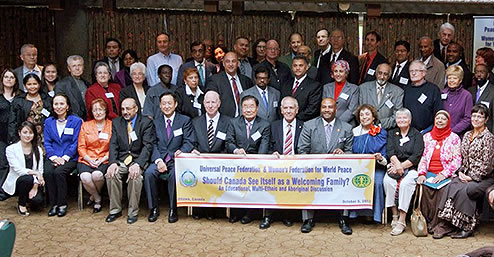
With this foundation in mind, WFWP and UPF in Canada have been working together to bring people of opposing views together for dialogue and cultural exchange. In November 2013, the organizations collaborated on two events.
The first event, held in Montreal on November 2, was titled “East Meets West.” About 50 people attended, including over 20 guests, to experience some of the rich cultural aspects of the East represented by Japanese, Filipino, Chinese, and Korean members. Participants watched dance and musical performances and partook in food from various countries. It was a celebratory fellowship, which gave people a glimpse into cultures that they perhaps had never experienced before.
On November 21, UPF in partnership with WFWP sponsored a forum on the topic “Is There a Conflict between the Secular State and a Religiously Inclusive Society?” This was a more political and academic exchange than the festive cultural celebration, but it served a similar purpose—bringing people together for meaningful exchange. Both WFWP and UPF asserted that a family model can help resolve the tensions between a secular state and a religiously inclusive and pluralistic society.
Concerned citizens, religious and community leaders, and academics gathered to explore elements of this politically charged theme. The emphasis was placed on listening to various views and having respectful, open dialogue on some important issues. Leaders and representatives from different perspectives were able to present their side.
Rev. James Pratt, an Anglican priest in Montreal with a background in law, used the history of the Anglican Church as it adapted to various cultures throughout the period of colonialism to explain the need for dialogue and understanding among the communities.
Mr. Kaz Masciotra, a political science student, explained the historical context of a secular society and presented his view that “common ground needs to be reached by agreeing on what is ‘sacred’ not only in the religious sphere but in cultural and other areas as well.”
The speakers touched upon relevant current events as well as ethical concerns over the role of the state to legislate criteria for social values. Such thorny issues can often dissolve into hostile arguments; however, the spirit of the event fostered respect from both sides, even where they might disagree.
This has been part of the mission of WFWP and UPF all along: holding events at which people can celebrate and learn about their differences, and to even come to a place where they might agree. Conflicts often arise not just from a disagreement on a particular issue but because of a fundamental misunderstanding of the other side. By bridging that gap, allowing each other to see our mutual humanity, we are able to work together, even in a small or symbolic way. It is one step closer to healing conflicts between all people and creating a world of peace.