
Harnessing the Power of Forgiveness
Dr. Michael Balcomb, President of FFWPU USA, gave the main Sunday Service address at the Bay Area Family Church April 12, 2015. He spoke about harnessing the power of forgiveness. Read the full message below.
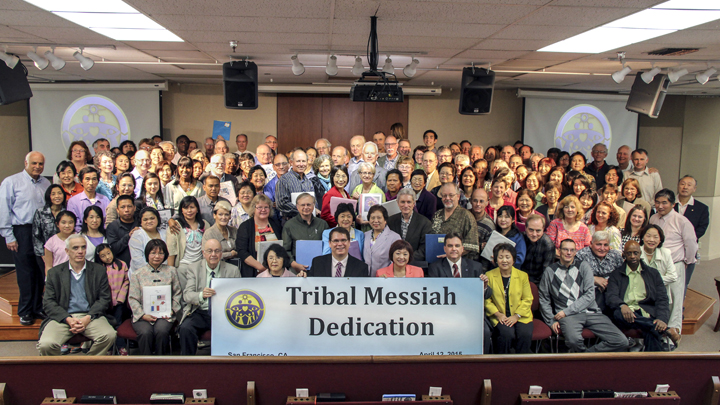
Families of the Bay Area Family Church held a dedication ceremony after Sunday Service for the fulfillment of Tribal Messiahship, April 12, 2015.
Thank you, everybody. Good morning. Pastor Kevin Thompson said that it’s an impossible job to be church president, but actually with God all things are possible. Today I’d like to share about the most difficult part of being president; is that okay?
Seventy Times Seven
The topic is “Seventy Times Seven,” so of course this is a sermon about forgiveness. For those of you who may need a little refreshing, as I did myself, I’d like to continue with the Gospel of Matthew, Chapter 18. Peter had asked Jesus, “How many times shall I forgive my brother or sister?” Already that’s interesting, right? Not asking, “How many times shall I forgive the Romans, who are making our lives difficult and persecuting our people?” It’s not asking, “How many times shall we forgive the high priest and scribes and Pharisees who are challenging us, challenging your authority, challenging us that we’re not of God?” No, he’s asking, “How many times shall I forgive the person who’s most difficult to forgive, which is often the person very closest to you?”
When he said, “Seven times,” you should know that the standard in those days was three times. So when Peter said, “Seven times,” he probably thought to himself, “I’m going to look good by saying, ‘Seven times.’” The standard the rabbis taught was three times. After three times, no more forgiveness. Of course, Jesus said, “Not seven times, but 70 times seven,” but then he went on to illustrate what that means.
“Therefore, the Kingdom of Heaven is like a king who wanted to settle accounts with his servants. As he began the settlement, a man who owed him 10,000 talents was brought to him.”—We’ll come back to how much a talent was, but typically it was about 20 years of wages. 10,000 talents is about 200,000 years of debt.—“Since he was not able to pay, the master ordered that he and his wife and children and all that he had be sold to repay the debt. At that the servant fell to his knees and said, ‘Be patient with me, and I will pay everything.’”—Obviously not true, how to pay back 200,000 years?—“But the king had mercy and canceled the debt and let him go. But when that servant went out, he found one of his fellow servants who owed him 100 denarii.”—One denarius is one day’s wages, so three months wages—“He grabbed him and began to choke him. ‘Pay back what you owe me!’ he demanded. Likewise his fellow servant fell to his knees and begged him, ‘Be patient with me, and I will pay it back.’ But he refused.
Instead he went off and had the man thrown into prison until he could repay his debt. When the other servants saw what happened, they were outraged and they went and told their master everything that had happened. Then the master called the servant. ‘You wicked servant,’ he said, ‘I canceled all that debt of yours because you begged me to. Shouldn’t you have had mercy on your fellow servant, just as I had on you?’ In his anger his master handed him over to the jailers to be tortured, until he should pay back all he owed.”—Just in case this message wasn’t clear, Jesus slipped this knife between the ribs—“This is how my Heavenly Father will treat each of you unless you forgive your brother and sister.” (Matthew 18:23-35) That’s pretty clear and straightforward. Forgiveness is not just a good idea, not just a good thing; it’s actually commanded by God.
Forgiveness is a Part of God’s Design
Let me ask you a question: If there had been no sin, if Adam and Eve never ate that apple, or fell and misused love, would there be a need for forgiveness or repentance in human life? I see a shaking head over there. How many people think no? How many people think yes? All the married men, for sure. Actually forgiveness and repentance are part of God’s design for human life, because He made us to grow to perfection, to grow to be like Him, to grow to maturity, and along the way it’s inevitable you’re going to make mistakes. You’re going to do foolish things, and you’re going to need forgiveness quite a lot, but God made it that way because He intended that we become like Him, able to love, to forgive, to care for anything—even the unlovable, even the unforgivable.
We’re supposed to go through that experience, and come out on the other side mature and complete, so we have to learn how to give that forgiveness and also to receive it. Still, some people say, “Well, look, if it’s money, if it’s a matter of a debt that somebody owes, I can understand forgiving them, but what if the sin is much worse than that? Suppose it’s the sin of, for example, a father raping his daughter, murder, incest, some sin that deeply wounds and hurts many other people, a betrayal of the deepest kind?” In the Gospel of Luke, Jesus answered that question too, the same parable, but with a little more. That’s where we hear Jesus saying, “You have to rebuke the sin, but you have to love the sinner, and if there’s a danger that that sinner, that person, is going to keep on repeating the crime or the sin, you have to stop him, if necessary by force or by restraint.”
Forgiveness doesn’t mean just turning the other cheek again and again and again. It also means taking responsibility to prevent continued wrongdoing. Luke also goes on to say that you shouldn’t forgive unless they repent first. What do you think about that idea? Who thinks that’s a good idea? How many can forgive if the other person is repentant? One? Oh. Think about what that would mean if you could only forgive someone who’s already repenting, already come to a realization of their misdoing. That would actually mean you’d be forgiving a person who doesn’t need forgiving anymore, because already by themselves they’ve realized, “I need to change.”
It’s not a long step from expecting someone to repent to us before saying, “I want justice. I’ll forgive only if this situation is resolved fairly and justly. I’m not going to forgive if there’s wrongdoing, as long as I’m still hurt.” If you call for justice, it’s not a long step from there to want revenge. What you really want is not for things to be fair—you want retribution. You want an eye for an eye, a tooth for a tooth, but as Dr. Martin Luther King said, that kind of morality means that soon we’ll have a world of blind people.
Walking in the Footsteps of God
Forgiveness is actually really deep and challenging. Seventy times seven means forgiving the unrepentant. It means forgiving people who have done things that deeply hurt and betray you. It means you can’t wait for someone to say sorry, and it means you have to give up and let go of the idea that things are going to be fair, because they’re not going to be fair. But by doing that, we start to walk in the footsteps that God, and Jesus, and True Parents commanded us to. When we don’t forgive, actually we’re the ones who suffer the most. Unforgiveness begins to grow in our relationships. Unforgiveness in our church will destroy our church. Unforgiveness in our family will destroy everything that we have. Actually more than that, it will stop God’s plan for my life.
In Jeremiah 29:11, my favorite Bible verse, Jeremiah declares in the name of God, “I know the plans I have for you, declares the Lord. Plans to prosper you, not to harm you, to give you hope and a future.” God has a plan for every human life, even the most miserable and dejected. He has a plan for each one of us, but for that plan to come to fruition God needs our cooperation. You’ve heard about Plan B, right? But God also has a Plan Z, and a Plan D, and a Plan ZZ—in my case. God always has a plan, and that plan is always the best available at this time. Yes, there might have been a better plan in the past that would’ve been available if you had made this decision or that decision, but God’s new plan will get you back to the same place, but you have to embrace it.
However, if we can’t forgive, if we can’t let go, then God’s best plan for me right now is going to be frustrated, and we won’t be the people that God would like us to be. The rabbis used to say that we are made so powerful that demons tremble. Think about that. Kind of a nice feeling, right? Not just the sort of demons you’ve seen in movies, but the demons that are far more psychological and internal, the demons of depression, or doubts, the demons of feeling unloved, or a lack of confidence; those things can tremble and run away when the power that God has for each of our lives is allowed to develop and grow. But the key for that, again, is to be forgiven and to forgive.
Letting Go
Jesus said that when we forgive, God forgives us and we become people of power. Now the Greek term for “forgiveness” is actually very revealing. It means “to let go.” To let go. Maybe just right now, before I say another word, I need you to just close your eyes, and think about one thing that you need to let go this morning. Okay, now I’ve always been inspired by the example, the living example, of True Parents, and especially of True Father, Rev. Sun Myung Moon. I want you to think about three instances when True Father practiced forgiveness and it changed things deeply.
The first experience, which is also recounted in his autobiography, As a Peace-Loving Global Citizen, came right at the end of World War II. For those of you who haven’t read it, Korea was occupied by imperial Japan. Not just during the war, but for 35 years beforehand.
Truth be told, most Koreans suffered a great deal under Japanese colonialism, and toward the end of the war they suffered even more because with not enough food and not enough resources, Koreans came second, Japanese came first. Koreans were being conscripted to the Japanese army; even today there’s a great conflict of Korea and Japan over Korean women who were forced to be sexual slaves for Japanese soldiers. The feeling of antagonism and resentment between the Korean people and the Japanese at that time was really at a high pitch.
True Father, himself, was known to the Japanese as a revolutionary, a patriot; he had been arrested, tortured, beaten several times for his work in trying to bring an end to Japanese occupation, and lucky to still be alive. But on the night that the war ended, his mind turned toward a Japanese police officer who was not far away, who was hated in the neighborhood, hated for what he had done to the people, hated for his unfairness, and he went to his house and he told him, “You have to leave tonight or you will surely die tomorrow. I will help you. I will help you to leave.” He says, “I helped him to pack a few belongings, to gather his wife and child, and to leave under the cover of darkness.” Probably at the same time when everybody else would have loved to have seen that man arrested, jailed, perhaps killed on the spot.
To think about that, I grew up in Nigeria, and if somebody was caught stealing, they would also be killed on the spot. On the spot by a crowd. It was a horrible, lawless time. But he helped that man escape. He said later, “Because I did that, all the pain and anguish I had toward the people of Japan were washed away. I found later that young Japanese men and women wanted to follow me, wanted to serve me, wanted to see my ideals come to pass, but it wouldn’t have happened if I had not learned how to forgive.”
The second time when he practiced such forgiveness was in 1991, when he went to North Korea and met Kim Il Sung, the dictator of North Korea for many years, and again he had every reason to be resentful toward Kim Il Sung. He’d been imprisoned in North Korea for almost three years in a communist death camp where most prisoners survived only a few months. He managed to live for 2½ years, and had been tortured, of course, starved, betrayed, but when he went back, he said, “I felt that I was not going into the house of my enemy but to the home of my brother, and I embraced him, and I loved him, and I changed his heart.”
Today, of course, 20 years later, still there are a great deal of tensions between the two Koreas. In a recent Hoon Dok Hwe message on April 1, True Mother said that one of her primary goals before 2020 was to end this division, but the good relationship between the Kim family and the Moon family still continues 20 years later because of that demonstration of forgiveness.
Forgiveness for Our Ancestors
And there’s one more example of forgiveness I’d like to share with you this morning, and that was when True Father forgave me. He forgave me many times, but there’s one incident that really remains deeply in my mind.
I was at East Garden, and True Father was giving a long, long message. By “long,” I mean that breakfast had passed, and lunch had passed, and we’re about 8 or 9 hours in. I want you to have that experience this morning, so cancel any lunch plans you may have; we’ll be here till about 5. He came to a topic that he used to like to exercise, which was the perfidy of the British. One word he often had for the British was that we are a “pirate race” of thieves and vagabonds. In particular, he used to like to explain how the British Museum was a treasure store of stolen goods.
Actually True Father liked the British Museum, but if you’ve ever been there, you can’t help notice that it’s mostly full of things that are not British. There’s the Stele of Cyrus the Great of Persia, the most precious and valuable piece of Persian history going back 4,000 years, but it’s not in Tehran, it’s in London. There are the Elgin Marbles [marble sculptures] from the Parthenon in Greece that used to decorate the frieze that went around the most iconic of Greek buildings.
Actually there’s a Parthenon Museum in Athens, I went there a few years ago, and they’ve deliberately left black holes to show where the missing pieces should go that are in Britain. But at least in some of these cases, if the British had not taken care of these items, at least in some cases they would’ve been destroyed and lost in the mud, sold, broken. That’s why there isn’t a museum like that in Korea. There are places like France, and Britain, and Berlin, and, yes, they have a long history behind them. Anyway, back to True Father.
He’s really driving the point home about how bad the English are. I have to tell you, it’s wrong to hate the Messiah, our True Parents, I know that’s a sin, but I’m really struggling and I’m beginning to feel resentful. God, why did you send the Messiah to Korea? I don’t speak Korean. Why is he so uncivilized? Why doesn’t he appreciate art? How could he call us pirates? I’m not a pirate. Of course, none of this actually came out of my mouth.
I was sitting there, and finally the speech came to an end, and I swear this is true: Father got down, he walked up to me sitting there, and he looked me right in the eye, put his hand on my cheek and said, “You may be a pirate, but you’re my pirate.” I still haven’t forgiven, but—no, in that moment I really did feel love and forgiveness. Not just forgiveness of myself, but even forgiveness of my nation, my ancestry, all the people who went out from the West to the East and to Africa, and South America, believing, as we did, that we were doing the best, when so often the results were not the best at all. It actually caused a lot of grief and misery.
We all need forgiveness, of course. We need forgiveness from God for things that we’ve done, but also for things we haven’t done, for the things we have left undone or ought to have done, in the words of the English Queen. The words and acts of kindness that we could’ve done to other people, but we didn’t. We chose not to, because it required a little bit too much effort. Of course, we need forgiveness sometimes for the things we’ve done wrong that we’re deeply ashamed of, and you know what? Everyone has those things.
The beginning to real life, and to real life as one family under God, is to be able to let go of the things that we need to be forgiven for. Now I’m going to ask you to find your partner, probably the person you came to church with, but it doesn’t have to be, and we’re going to have a short pair-share. Usually I ask quite gentle questions, but today I’m going to ask you a challenging question. I’m going to ask you to share something either that you need to forgive and let go of, or where you need forgiveness and you need to be absolved.
So if you’re with your spouse, they’ll know what you mean. Even change the name, if you want to protect the innocent, but I want you to share those two things. Spend only about 4 minutes, so please make a pair. If you don’t have a pair, you can hold up your hand and somebody will come and be your pair-share. So you understand the question, right? I need to be forgiven for this, or I need to forgive this. Okay? Just quietly in pairs. … It’s not easy to stop. I give you permission to carry on after church; it’s all right. When we really taste forgiveness, it’s such a liberation. Such a liberation not to have to hide, not to have to lie, not to have to pretend, but just to really be who we are.
Unlocking the Secrets of God’s Heart
It’s within the power of each of us to give that experience to somebody else. You can’t, of course, go up to people and say, “I think I need to forgive you.” Doesn’t really work that way so well, but you can if you have somebody from whom you need forgiveness. You could even today call them, talk to them, and just tell them straight, “I need your forgiveness.” It would be such a transformative experience in life. Most of all, we do need the forgiveness of God. You might think, “What is it that gives God the most pain about my life, about who I am?” I thought that God loves me and He’s my Parent, and of course God loves us and He is our Parent.
For a long time, for almost 10 years, True Father wrestled with this question: What is it? What’s the key that will unlock all the secrets of the heart of God? It’s very moving, if you take some time to look in the book As a Peace-Loving Global Citizen. There’s a time where Father describes being a student in his 20s in Korea. He explains how he would go to school all day, and all night long he would pray. He would pray desperately, so desperately that his tears would soak his clothing, and sometimes even the floor, but no answer came. Nothing. He would pray again, night after night after night, and still no answer.
I think it’s around page 55, you could find it. He said, “Looking back years later, I could see already at that time God had given me the key to unlock the secrets of His heart, but because my prayer and my emotion was insufficient, His words, the door remained closed.” Then he went on to Japan where he studied more, but also as mentioned earlier, the student underground movement began working and fighting for his country’s liberation, and finally four to five weeks later he came back to Korea.
There, he recounts, on the train coming back to Seoul, suddenly, as if a projector had been switched on—they don’t use projectors anymore—but as if the whole story of human history from Adam and Eve onward began to play, as if on a video screen with every aspect of the human journey away, away, away from God shown in clear detail. It was at that moment, after 9½ years, that he received what he called the ultimate Truth of the Universe that God is our Parent and we are His children, and that there’s nothing that God wants or needs more than to re-establish that relationship.
The thing that hurts God the most, of all the things, is to not know Him. To not know our own Parent, to turn our back on Him. That was the sharp spike, as True Father called it. The sharp spike brought him into the heart of God, that after all these years that somebody could remove. We need to know God. We need to know Him as our Parent. The best way to do that is not just by prayer, but by actions, to be grateful, to be loving, to be unselfish, to care for God’s other sons and daughters. Actually any parent will tell you that will bring the most joy. Don’t tell Me you love Me; show Me by loving your brothers and sisters. Show Me by caring for the people whom I cannot touch or reach, and then forgiveness will come. Let us pray.
Lisa Take
| #
Thank you Dr. Balcomb for this heartfelt sermon, one that we should each copy and paste, keep in our pockets and pull out from time to time to read again. Truly, we’re at a tremendous loss when we think of forgiveness as a shortcoming or a sign of human weakness, but in the words of Mahatma Ghandi, “The weak can never forgive. Forgiveness is the attribute of the strong.” Now’s the appropriate time to prove how strong we truly are as a movement.
Reply
Carol Pobanz
| #
This is a powerful and timely message…Thank you Dr. Balcomb for bringing this message to the forefront. This was the topic our small group covered this week…and we too came to realize how lack of forgiveness deeply damages our own spirit and pulls us away from the “familyhood” of God and humanity.
Reply